





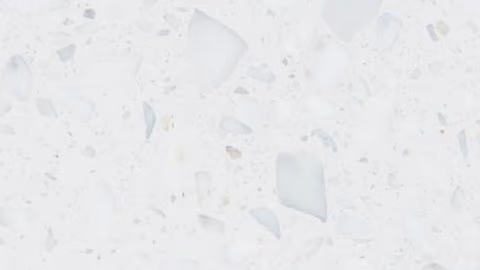






Choose filled travertine for indoor floors, bathrooms and walls, where a smooth, closed surface is easier to clean. Choose unfilled or tumbled travertine for an open, textured face, most often on outdoor paving, pool surrounds and rustic interiors.
The holes are natural in both. The choice comes down to appearance, cleaning and where the stone will be laid.
Holes in travertine
Travertine is a form of limestone laid down by mineral springs, many of them hot. As spring water reaches the surface, calcium carbonate comes out of solution and builds up in layers.
Gas bubbles, plant matter and other organic material are trapped as the layers grow. When the gas escapes or the organic matter decays, it leaves voids in the rock.
These voids run through the whole block, not only the face. Any saw cut exposes them, from pinholes to cavities wider than a fingertip.
Compare the scattered small holes in Beige Travertine with the larger, more visible voids in Red Travertine. The same layered growth also gives travertine its bands, which matter when you choose the cut.
The filling process
Filling closes the holes on the visible face of a slab or tile. A cement-based or resin filler is worked into the voids, tinted to match the ground colour of the stone.
Once the filler has cured, the face is ground flat and then honed or polished. The filler ends up flush with the stone, so the surface feels continuous underfoot.
The colour match is close but never exact. Up close, filled holes read as small flat patches with a slightly different sheen. At normal viewing distance they blend into the pattern.
Filling treats the face only. Voids deeper in the stone stay hidden until wear opens them, which is why filled floors need occasional touch-ups.
Unfilled and tumbled travertine
Unfilled travertine is cut and finished with the holes left open. A honed unfilled face is flat and matt, broken by small voids, and looks more weathered than filled stone.
Tumbled travertine is made by turning cut tiles in a drum with water and abrasive grit. The edges round off and the face softens, so new tiles look aged. Tumbled tiles are usually sold unfilled.
Brushed travertine sits between the two. Abrasive brushes wear away the softer parts of the face, leaving a gentle texture with a low sheen. Brushed stone can be supplied filled or unfilled.
Filled, unfilled and tumbled compared
| Filled | Unfilled | Tumbled | |
|---|---|---|---|
| Surface | Closed and flush | Open holes across the face | Open holes, rounded edges, worn face |
| Usual finishes | Honed or polished | Honed or brushed | Tumbled |
| Look | Calm and even | Textured, more natural | Aged and rustic |
| Cleaning | Easiest, nothing to trap dirt | Holes collect dust and grit | Holes collect dust and grit |
| Indoor floors | Yes, honed | Possible for a rustic look | Possible for a rustic look |
| Showers | Yes, honed and sealed | Not advised | Not advised |
| Outdoor paving and pool coping | Possible, expect some refilling | Well suited | Well suited |
| Façades | Yes | Yes | Not usual |
| Upkeep | Seal, refill holes that open | Seal, clean out holes | Seal, clean out holes |
Uses for each type
Floors
Filled and honed is the standard choice for indoor floors. Open holes collect grit and spills, and larger ones can catch narrow heels.
Polished travertine floors suit low-traffic rooms only. The gloss shows wear in walkways and becomes slippery when wet, so honed is the safer default for halls and hotel corridors.
Bathrooms and showers
Use filled travertine in bathrooms, honed rather than polished on any floor that gets wet. Open holes in a shower hold water, soap and hair, which is hard to clean and can stain.
Shower walls can be polished, since grip is not needed there. Seal the stone after grouting and keep to a resealing routine.
Outdoor paving and pool coping
Outside, unfilled or tumbled travertine is the usual choice. There is no filler to loosen in sun, rain and frost. A brushed or tumbled face also gives more texture underfoot than honed.
Filled travertine also works outdoors on a brushed face, but expect to refill some holes over time. Pale stone stays cooler underfoot in strong sun than dark paving, which helps around pools.
Coping with a rounded front edge can be cut to suit each pool. See made to measure for cut-to-size work.
Façades
Both types appear on façades. Unfilled stone gives a textured face with depth, while filled stone reads flatter and more uniform from the street.
The façade engineer sets thickness and fixings. In cold climates, the frost data of the specific stone decides if it is suitable.
Vein cut and cross cut
Because travertine grows in layers, the direction of the saw cut changes the pattern completely.
Vein cut slices across the layers. It shows straight, parallel bands, rather like timber grain, and the holes tend to stretch along the bands. Silver Travertine, Italy and Roman Travertine both show this kind of linear banding.
Cross cut slices along the layers. It gives a cloudy, mottled pattern with no clear direction, sometimes called fleuri, and the holes appear more scattered.
Vein cut needs a direction marked on the drawings. Bands running the length of a corridor look very different from bands running across it.
Consecutive vein-cut slabs can also be mirrored at a joint. Our guide to book-matched stone explains how to specify that.
Frost and outdoor use
Travertine is laid outdoors in many climates, but frost resistance varies from stone to stone and even between blocks. Water held in pores and holes expands as it freezes.
Repeated freeze-thaw cycles can crack the face, open new holes or push filler out. Before specifying travertine for cold-climate paving or façades, ask for freeze-thaw test data on that specific stone.
Do not assume one travertine behaves like another. Where the data falls short, terrazzo with a mineral binder is an alternative for paving. Ask for its freeze-thaw result too.
In hot climates, frost is not the concern. Choose a textured finish for wet areas around pools, and seal the stone to slow staining from spills and sun cream.
Finishes
Polished travertine is normally filled first, because a gloss broken by open holes looks patchy. Honed is the usual finish for floors and bathrooms.
| Finish | Appearance | Typical uses |
|---|---|---|
| Polished | Gloss that deepens the colour | Walls, low-traffic indoor floors |
| Honed | Smooth and matt | Floors, bathrooms, walls |
| Brushed | Soft texture, low sheen | Floors, terraces, pool surrounds |
| Tumbled | Rounded edges, worn face | Rustic floors, paving, pool surrounds |
| Bush-hammered | Even, rough texture | Outdoor paving, steps |
Finish availability depends on the stone. Datum supplies natural stone as full slabs or cut to size, 18, 20 or 30 mm thick as standard. Each quote states the finish.
If you want a pale stone with few visible holes, look at limestone instead. Moca Cream and Limestone White have a closer surface, so filling is rarely the question.
Maintenance
Seal all travertine, filled or unfilled, with a penetrating sealer after installation. Sealing slows the absorption of water, oil and spills, but it does not make the stone stain-proof.
Resealing intervals depend on the sealer and the traffic. For a simple check, drop water on the surface: if it darkens within a few minutes, reseal.
Travertine is calcium carbonate, like marble, so acids etch it. Clean with a pH-neutral stone cleaner, and wipe up citrus juice, vinegar and wine promptly.
On filled floors, new holes can open as traffic wears through thin skins of stone over hidden voids. This is normal and does not mean the stone is faulty.
Refill these holes with a colour-matched filler, let it cure, then level and hone the spot. Keep a small amount of the original filler, or a note of its colour, for this purpose.
Unfilled and tumbled surfaces need more frequent sweeping or vacuuming, since dirt settles in the holes. Outdoors, a stiff brush and clean water usually clear them.
Next step
Order samples of the travertines you are considering, or browse the full range in the catalogue. For a written quote, email contact@datumsurfaces.com with sizes, finish and location, and approve photos of the actual slabs before they ship.